
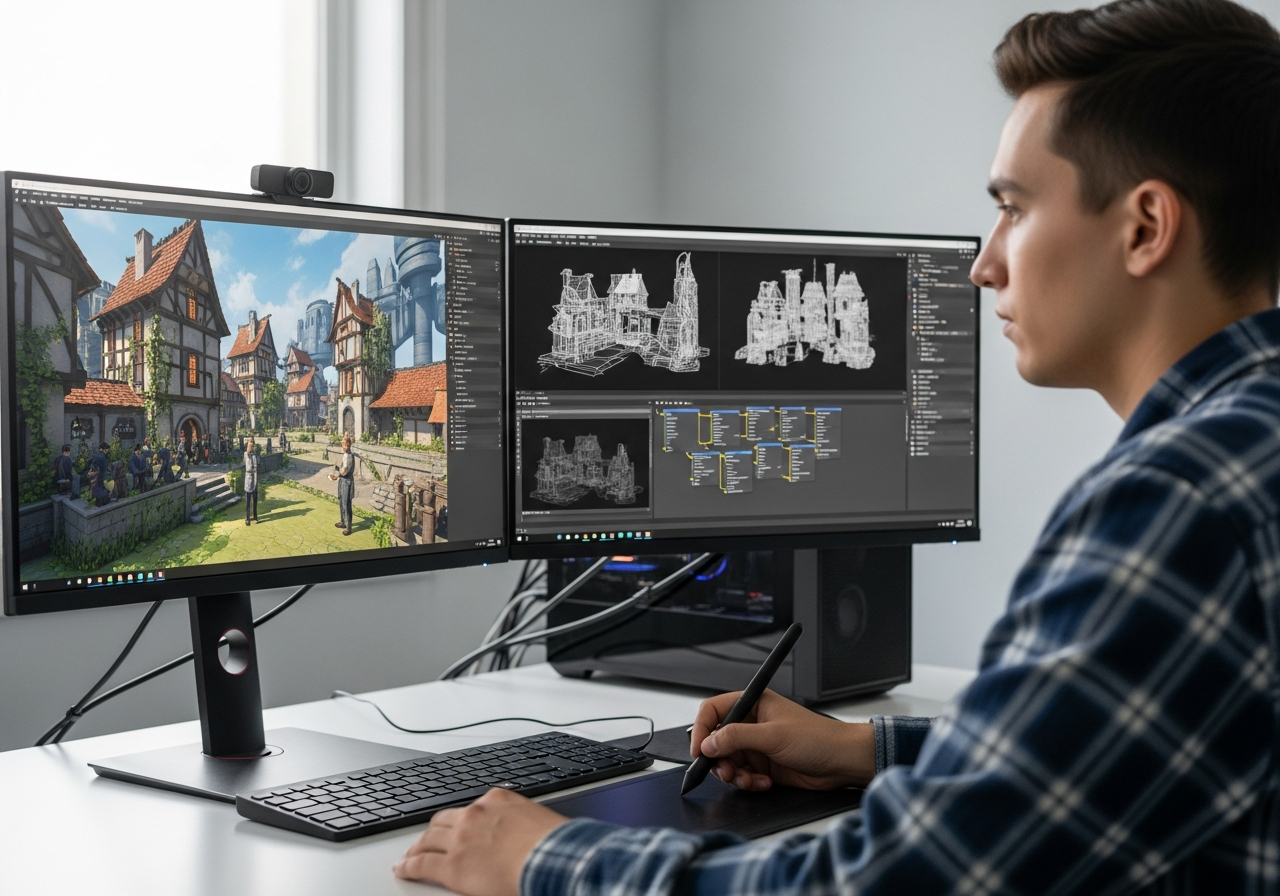
Vancouver’s game development scene has exploded over the past decade, with EA Vancouver leading the charge alongside a thriving ecosystem of indie studios and VFS graduates making their mark in the industry. For aspiring junior game environment artists, understanding what Canadian studios specifically look for in a portfolio can mean the difference between landing that first role or getting lost in the pile of applications.
The current meta for junior environment artist portfolios has crystallized around a simple but effective formula: one to two modular environments paired with a single hero prop, all supported by comprehensive technical breakdowns. This isn’t about quantity – it’s about demonstrating quality craftsmanship and technical understanding that Canadian studios can immediately recognize and value.
The Current Portfolio Meta for Junior Environment Artists
The standard that has emerged across Canadian studios, particularly influenced by YouTube tutorials and industry best practices, centers on showcasing one to two modular environments alongside a single hero prop. This formula has gained traction because it demonstrates both technical versatility and artistic vision without overwhelming recruiters with too much content to evaluate.
This approach reflects the current industry trend toward modular asset creation, which Canadian studios heavily rely on for efficient production pipelines. EA Vancouver, in particular, has been vocal about their preference for artists who understand modular workflows, as these skills translate directly into their production environment where assets need to be versatile and reusable across multiple projects.
The emphasis on quality over quantity has become even more pronounced as studios receive hundreds of portfolio submissions. Recruiters typically spend less than five minutes on initial portfolio reviews, making it crucial that every piece demonstrates clear technical competency and artistic growth. The meta has shifted away from large, sprawling environments toward focused, well-executed pieces that tell a complete story about an artist’s capabilities.
YouTube influencers and industry mentors have reinforced this approach, with many successful environment artists crediting their breakthrough to portfolios that followed this exact formula. The trend reflects a broader understanding that junior positions require demonstrable technical skills rather than ambitious artistic concepts that may lack proper execution.
Why Small Scope Works Best
- Focus on architectural modeling fundamentals rather than attempting massive cityscapes that dilute attention from core skills
- Avoid overwhelming complexity that prevents proper optimization and clean topology demonstration
- Concentrate on perfecting lighting and material work within a contained space where every element can be polished
- Demonstrate complete ownership of every asset in the scene, showing versatility in creating diverse props and structures
- Allow time for proper documentation and breakdown creation, which Canadian studios consider essential
- Enable faster iteration and refinement, leading to higher overall quality that impresses recruiters immediately
Buffer Views and Breakdowns Are Essential
Canadian studios place exceptional emphasis on technical breakdowns that showcase RGB masks, trim sheet usage, and shader work. These breakdowns serve as proof that artists understand the technical pipeline beyond just the final beauty shots. Studios want to see wireframe views, texture sheets, and material setups that demonstrate real production knowledge.
The breakdown presentation has become as important as the final renders themselves. Studios specifically look for artists who can communicate their technical process clearly, as this translates directly to collaborative work environments where explaining workflows to team members is crucial for project success.
Canadian Studio Landscape for Junior Hires
The Canadian game development landscape offers diverse opportunities for junior environment artists, with each studio type having distinct preferences for portfolio content. Vancouver remains the epicenter of this activity, housing major international studios alongside innovative indie developers and established VFX houses transitioning into games.
Understanding the specific expectations of different studio types can help junior artists tailor their portfolios effectively. While the core meta of modular environments and hero props remains consistent, the emphasis on particular technical skills and artistic styles varies significantly between studio categories.
The hiring preferences across Canadian studios reflect the country’s unique position in the global game development ecosystem, with strong connections to both American AAA development and independent creative communities. This creates opportunities for artists who can demonstrate versatility while maintaining technical excellence.
| Studio Type | Hiring Preferences | Portfolio Focus | Examples |
|---|---|---|---|
| AAA Studios | Technical specialization and pipeline knowledge | Modular workflows, optimization proof | EA Vancouver, Ubisoft Toronto |
| Indie Studios | Versatility and creative problem-solving | Diverse styles, broad skill range | Klei Entertainment, Thunder Lotus |
| VFX Houses | High-fidelity modeling and texturing | Photorealistic environments | Image Engine, Scanline VFX |
| Mobile Game Studios | Performance optimization focus | Low-poly efficiency, stylized work | East Side Games, A Thinking Ape |
| Serious Games | Educational content creation | Clear visual communication | Fuel Industries, Serious Labs |
EA Vancouver Specific Expectations
EA Vancouver represents the gold standard for AAA environment art positions in Canada, with specific requirements that reflect their large-scale production needs. Their hiring process focuses heavily on technical competency and the ability to work within established pipelines, making portfolio demonstration of these skills crucial for applicants.
The studio’s emphasis on sports games and action titles means they particularly value artists who can create both realistic and stylized environments with equal skill. Their interview process often includes technical discussions about asset creation, so portfolio breakdowns need to demonstrate deep understanding of the entire pipeline from concept to engine implementation.
- Demonstrate modular geometry creation with clean, production-ready topology that shows understanding of edge flow and optimization principles
- Showcase texture atlas efficiency and trim sheet usage that reflects real production constraints and memory budgets
- Present engine implementation knowledge through Unreal Engine 4 or 5 scenes that demonstrate lighting and material setup competency
- Include performance metrics and polygon counts that show awareness of technical limitations in shipping products
- Display collaboration readiness through clear file organization and documentation that other team members could easily understand and iterate upon
Core Portfolio Pieces Recruiters Want
Recruiters across Canadian studios consistently look for specific portfolio elements that demonstrate both technical competency and artistic vision. The emphasis falls heavily on modular environments that showcase versatility between urban and natural settings, paired with hero props that display material variety and attention to detail.
The key lies in selecting pieces that demonstrate range while maintaining consistent quality and technical excellence. Studios want to see that junior artists can handle diverse project requirements while maintaining the technical standards necessary for production environments.
- One modular urban environment demonstrating architectural modeling skills and hard surface techniques
- One modular natural environment showcasing organic modeling and terrain work capabilities
- A hero prop with multiple material types that demonstrates texturing versatility and attention to detail
- Complete technical breakdowns showing wireframes, texture sheets, and material setups for all pieces
- Engine implementation showing lighting setup, post-processing, and real-time rendering knowledge
- Optimization demonstrations including LOD creation and performance considerations
- Clear presentation on ArtStation or similar portfolio platform with professional layout and descriptions
Modular Environment Breakdown
Canadian studios place exceptional value on modular environment creation because it directly translates to production efficiency. Understanding how to break down environments into reusable components while maintaining visual cohesion represents a core skill that separates junior artists ready for professional work from those still developing fundamental competencies.
The technical requirements for modular environments extend beyond simple asset creation into understanding memory budgets, texture atlasing, and optimization strategies. Studios want to see evidence that artists can think systematically about asset creation while maintaining artistic quality throughout the process.
Successful modular environment breakdowns demonstrate not just technical execution but also creative problem-solving in how assets can be combined and recombined to create visual variety. This flexibility becomes crucial in production environments where time and budget constraints require maximum asset reuse.
The presentation of modular breakdowns has become increasingly sophisticated, with studios expecting clear documentation of trim sheet usage, RGB mask implementation, and material variation strategies. This documentation serves as proof that artists understand the full pipeline from initial modeling through final engine implementation.
| Element | Technical Requirement | Why Studios Care |
|---|---|---|
| Trim Sheets | 1024×512 or 2048×1024 with efficient UV layout | Memory efficiency and texture budget management |
| RGB Masks | Channel-packed variation maps for material blending | Runtime material variation without additional textures |
| Modular Pieces | Grid-based with snapping points and clean topology | Level designer workflow efficiency |
| LOD Chains | 3-4 levels with appropriate polygon reduction | Performance scaling across hardware configurations |
| Lightmap UVs | Non-overlapping channel 2 with proper padding | Baked lighting quality and artifact prevention |
| Material Setup | PBR workflow with proper metallic/roughness maps | Industry standard rendering pipeline compatibility |
| Vertex Colors | Strategic use for wear patterns and variation | Additional variation without texture memory cost |
Hero Prop Selection Guide
Hero props serve as the showcase piece that demonstrates an artist’s ability to create detailed, engaging assets that draw player attention and enhance environmental storytelling. Canadian studios particularly value props that exhibit “charm” – a quality that goes beyond technical competency to show personality and creative thinking in asset selection and execution.
The most successful hero props demonstrate material variety through a single asset, allowing artists to showcase their texturing skills across different surface types within a cohesive design. This approach proves more valuable than creating multiple simple props, as it demonstrates the depth of skill that studios can apply to diverse project needs.
Material variation within hero props has become increasingly important as studios look for artists who understand how different surfaces interact with lighting and how to create visual interest through contrast and complement. The ability to make metal, fabric, wood, and other materials feel authentic while maintaining artistic cohesion separates strong candidates from the competition.
Technical Skills Canadian Studios Prioritize
Canadian studios have developed specific technical expectations that reflect their position in the global game development ecosystem, with particular emphasis on optimization and pipeline efficiency. These skills represent the difference between portfolio pieces that look impressive and those that demonstrate production readiness.
The technical landscape has evolved significantly with the adoption of real-time ray tracing and advanced rendering techniques, but Canadian studios still prioritize fundamental optimization skills that ensure games run smoothly across diverse hardware configurations. This practical approach reflects the market realities of shipping games to broad audiences.
Understanding engine-specific workflows has become increasingly important, with most Canadian studios standardizing on either Unreal Engine or Unity for their primary development pipelines. Artists who can demonstrate deep knowledge of these tools show immediate value to potential employers.
Shader creation and material authoring represent emerging expectations for junior environment artists, as studios increasingly expect artists to implement their own materials rather than relying solely on technical artists for material setup and optimization.
| Skill | Must-Have Tools | Portfolio Demo | Studio Notes |
|---|---|---|---|
| 3D Modeling | Maya, 3ds Max, Blender | Clean wireframes and topology breakdowns | Industry standard pipeline compatibility essential |
| Texturing | Substance Painter, Substance Designer | PBR material breakdowns with source files | Substance skills increasingly non-negotiable |
| Engine Implementation | Unreal Engine 4/5, Unity | Lighting setup and material creation | Real-time implementation proves production readiness |
| UV Mapping | Maya, 3ds Max, RizomUV | Efficient atlas layouts and seam placement | Foundation skill that affects all downstream work |
| Baking | Marmoset Toolbag, xNormal | High to low poly workflow examples | Quality bakes separate professional from amateur work |
| Optimization | Engine profilers, Simplygon | Performance metrics and LOD demonstrations | Critical for console and mobile development |
| Shader Creation | Unreal Material Editor, ShaderGraph | Custom material networks and effects | Emerging expectation for junior positions |
Optimization for Game Engines
Canadian studios place exceptional emphasis on optimization skills because their games often target multiple platforms with varying performance capabilities. Understanding how to balance visual quality with performance constraints represents a crucial skill that distinguishes production-ready artists from those still developing technical competency.
Frame rate considerations have become increasingly complex with the adoption of ray tracing and advanced lighting techniques, requiring artists to understand not just polygon optimization but also how lighting and material complexity affects overall performance in real-time rendering scenarios.
- Demonstrate LOD creation with appropriate polygon reduction that maintains silhouette integrity at distance
- Show texture resolution scaling and compression understanding for different platform targets
- Present draw call optimization through efficient material usage and texture atlasing strategies
- Include performance profiling screenshots showing frame rate impact of optimization decisions
- Display culling and occlusion awareness through strategic geometry placement and modeling decisions
- Showcase shader optimization knowledge through performance-conscious material creation and complexity management
Presentation and Polish Tips
Portfolio presentation has become increasingly sophisticated as Canadian studios receive hundreds of applications for each junior position. The way work is presented often matters as much as the quality of the work itself, with recruiters forming immediate impressions based on portfolio organization and professional presentation standards.
ArtStation has emerged as the standard platform for portfolio presentation, with specific best practices that Canadian studios expect to see. Understanding how to leverage the platform’s features effectively can significantly impact the visibility and professional perception of portfolio work.
The emphasis on breakdowns-first presentation reflects the technical focus of Canadian studios, where demonstrating understanding of the creation process often matters more than beauty shots alone. This approach shows studios that artists can communicate effectively about their work and understand the technical implications of their creative decisions.
- Lead with technical breakdowns and wireframes before showing beauty shots to demonstrate process understanding
- Organize content hierarchically with the strongest piece first and supporting work following in order of quality
- Include detailed descriptions explaining technical decisions and creative problem-solving approaches
- Optimize image compression and loading times to ensure smooth browsing experience across devices
- Maintain consistent visual branding across all portfolio pieces with unified color schemes and typography
- Provide downloadable technical documentation for key pieces to show deeper technical understanding
- Update portfolio regularly with new work and refined presentations of existing pieces
Portfolio Structure Blueprint
The ideal portfolio structure for Canadian studios follows a specific hierarchy that prioritizes technical demonstration while maintaining visual appeal. Understanding this structure can help junior artists organize their work in ways that align with recruiter expectations and evaluation criteria.
The three to five piece limit has become standard because it forces artists to curate their strongest work while providing enough variety to demonstrate range. This constraint also respects the time limitations that recruiters face when reviewing multiple portfolios daily.
Genre variety within the limited piece count shows versatility while maintaining focus. Studios want to see that artists can adapt to different project requirements while maintaining consistent technical and artistic quality across diverse style requirements.
Content priority ranking helps artists understand which pieces deserve the most attention and polish. This strategic approach to portfolio development ensures that limited time and energy are invested in the elements that will have the greatest impact on hiring decisions.
| Section | Content Priority | Example Pieces |
|---|---|---|
| Hero Environment | Highest – Lead with strongest technical piece | Modular urban scene with complete breakdowns |
| Secondary Environment | High – Demonstrate style versatility | Natural environment or contrasting architectural style |
| Hero Prop | Medium – Show detailed texturing skills | Complex prop with multiple material types |
| Supporting Work | Low – Fill gaps in demonstrated skills | Additional props or technical studies |
Common Mistakes to Avoid
Junior environment artists frequently fall into predictable traps that immediately signal inexperience to Canadian studio recruiters. The most damaging mistake involves creating overly complex models that sacrifice technical excellence for ambitious scope, resulting in portfolios that impress at first glance but fail to demonstrate production readiness upon closer inspection.
The absence of technical breakdowns represents another critical error that eliminates candidates from consideration regardless of their artistic ability. Canadian studios need to see process documentation because collaboration requires artists who can explain and iterate on their work based on feedback from technical directors and other team members.
Presentation inconsistencies undermine otherwise strong portfolios by suggesting lack of attention to detail and professional standards. Studios interpret poor presentation as an indicator of how artists might handle project deliverables and communication with team members, making this a crucial area for portfolio development focus.
Indie vs AAA Portfolio Adjustments
- Indie advantage: Demonstrate broad skill range including concept work, lighting, and post-processing beyond just asset creation
- Indie disadvantage: May lack depth in specialized areas that AAA studios prioritize, requiring focused skill development
- AAA advantage: Deep specialization in environment art tools and optimization techniques that show production scalability
- AAA disadvantage: Narrow focus may not demonstrate creative versatility that indie studios value for small team environments
- Indie preference: Show ability to wear multiple hats and adapt to changing project requirements with flexible skill application
- AAA preference: Demonstrate mastery of specific pipeline stages and ability to work within established technical constraints and team structures